


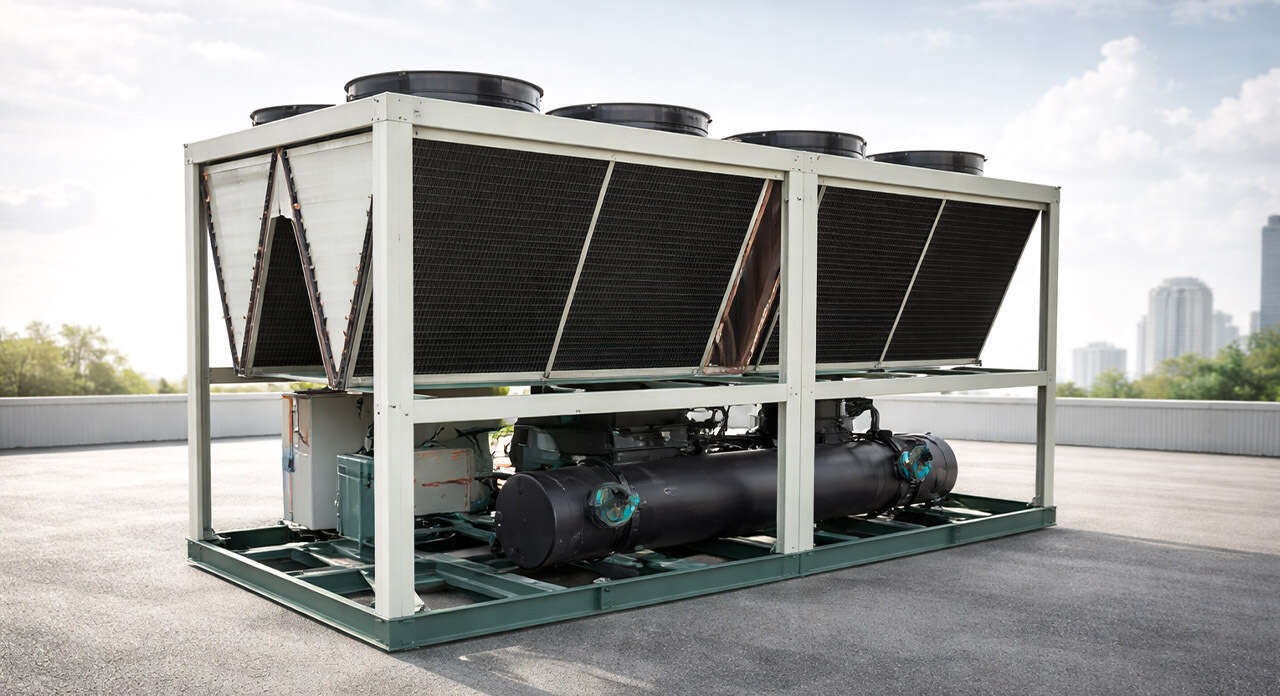
At first glance, the inlet and outlet water temperatures of a chiller appear to be just a few simple numbers on a thermostat or controller. In reality, however, these small values play a critical role in energy consumption, actual system performance, and the service life of equipment. Proper understanding and correct adjustment of these temperatures define the boundary between an efficient system and a costly, inefficient one.
What Do Chiller Supply and Return Water Temperatures Mean?
In a chilled water system, water leaves the chiller to cool the indoor air through fan coil units or air handling units, and then returns to the chiller after absorbing heat from the space.
Chilled Water Supply Temperature:
The temperature of the water leaving the chiller to provide cooling to the conditioned space.
Chilled Water Return Temperature:
The temperature of the water returning to the chiller after absorbing heat from the environment.
ΔT (Delta T):
The difference between the supply and return water temperatures, which is a key indicator for evaluating proper system operation and performance.
Standard Chiller Water Temperature Values
In general, and in accordance with international standards such as AHRI and ASHRAE, the typical design temperatures for a vapor-compression chiller system are as follows:
| System Type | Chilled Water Supply Temperature (°C) | Return Water Temperature (°C) | ΔT (Temperature Difference) |
|---|---|---|---|
| Typical Office and Residential Projects | 7 | 12 | 5 |
| High-Efficiency Projects | 6 | 12-13 | 6-7 |
| Hot and Humid Regions (e.g., Khuzestan) | 7 | 14-15 | 7-8 |
In hot and humid climates such as Ahvaz and Bandar Abbas, higher return water temperatures are often used in order to increase the temperature difference (ΔT) and, as a result, achieve better system efficiency.
Why Is ΔT Important?
Many chiller performance problems originate from a reduced ΔT. When the temperature difference between supply and return water drops below the design value, the chiller is forced to operate longer and harder to reach the setpoint temperature.
Effects of Reduced ΔT:
- Up to 30% increase in compressor energy consumption
- Reduction in the actual cooling capacity of the chiller
- Increased number of start–stop cycles (leading to reduced compressor lifespan)
- Fluctuations in the supply air temperature from fan coil units
- Frequent alarms triggered in the chiller controller
Causes of Reduced ΔT in Projects
In many projects, ΔT is observed to be lower than the design value. The most common reasons include:
- Excessive water flow rate in the circuit: Pumps deliver more flow than required, reducing the water contact time with the coils.
- Coils or fan coils with insufficient heat transfer surface: Caused by improper heat exchanger design.
- Malfunction or improper control of valves or thermostats
- Chiller setpoint temperature set lower than the actual cooling demand
- Uneven temperature distribution within the piping network
Proper Temperature Adjustment to Improve Efficiency
Professional engineers, when designing chiller systems, calculate the cooling load and optimal flow rate accurately and set temperatures in a way that:
- Adequate cooling is provided, and
- The system operates with minimum electrical energy consumption.
In general:
- Excessively lowering the chilled water supply temperature (for example, from 7°C to 5°C) increases load demand and power consumption.
- Excessively increasing the return water temperature leads to reduced cooling performance.
Southern Climate Conditions and Intelligent Setpoint Adjustment
In regions such as Ahvaz, Dezful, or Bandar Mahshahr, where ambient temperatures are high, using higher return water temperatures (for example, 14–15°C) is very common.
Because with this approach:
- Chiller efficiency improves,
- Compressor operating pressure is reduced, and
- The system operates more stably.
In such climates, increasing ΔT rather than reducing it is the key to electrical energy savings.
Conclusion
The inlet and outlet water temperatures of a chiller may show only a few degrees of difference on the display, but precise control of these temperatures is decisive in:
- Energy efficiency,
- Actual system performance,
- Equipment service life, and
- Client satisfaction with stable and reliable cooling.
Final Note from Avash Sepidar Sepehr’s Experience
In many large-scale projects executed by the Avash Sepidar Sepehr team, proper adjustment of chilled water supply and return temperatures has resulted in up to 25% reduction in power consumption and extended compressor service life.
These small technical details are what distinguish an ordinary installation from a truly engineered implementation.


