


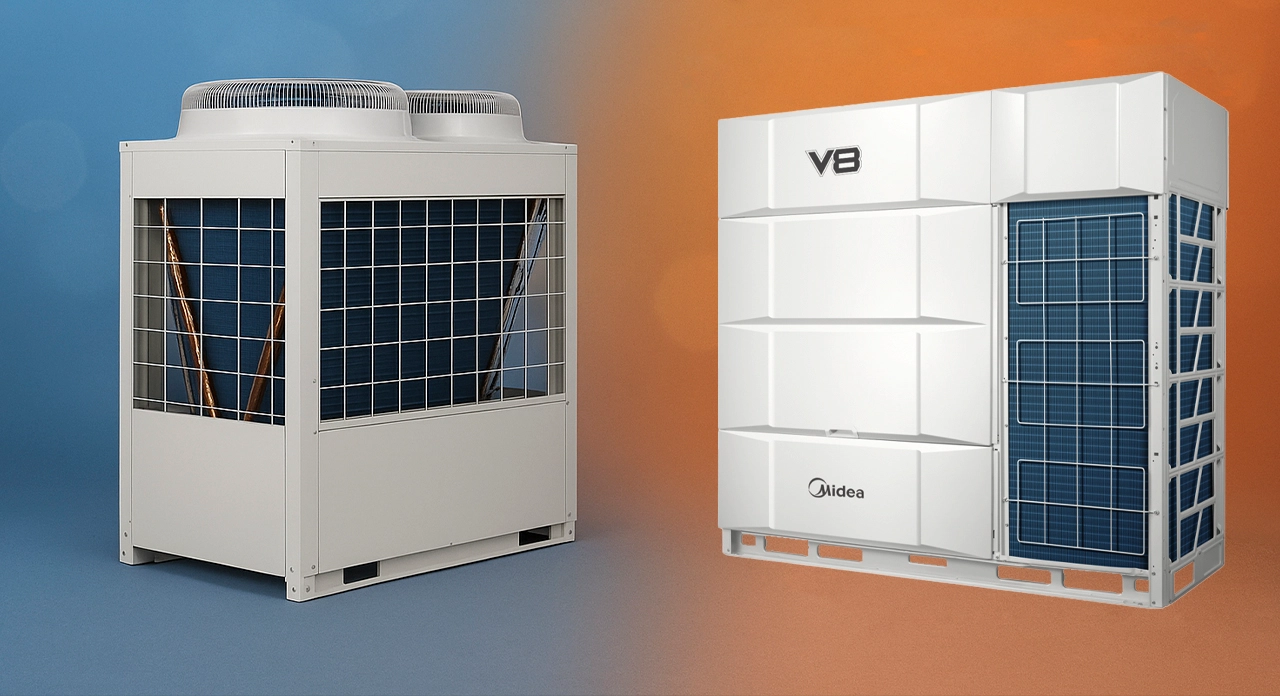
Air conditioning is one of the most important aspects of design and implementation in construction projects, whether residential, commercial, or industrial. Choosing the right system not only affects user comfort and well‑being but also plays a key role in long‑term energy and maintenance costs. Among the available options, VRF systems and chillers are two common choices, each with its own advantages and limitations.
In this article, we provide a comprehensive review and comparison of these two systems to determine which one is the better choice under different conditions, especially in terms of cost‑effectiveness and performance.
Introduction to the VRF (Variable Refrigerant Flow) System

The VRF (Variable Refrigerant Flow) system is one of the most advanced air‑conditioning solutions and was first introduced by Daikin of Japan. This system consists of one or more high‑capacity outdoor units and a large number of indoor units, which are connected to each other through copper pipes carrying refrigerant.
VRF is essentially a type of centralized split system that operates based on the vapor compression refrigeration cycle. Its main components include the compressor, condenser, expansion valve, and evaporator. In this system, instead of chilled water (as used in chillers), refrigerant is used directly for cooling and heating. The inverter compressors installed in the outdoor units can regulate the refrigerant flow according to the demand of each indoor unit, which is why it is called “Variable Refrigerant Flow.
One of the most important advantages of VRF systems is independent temperature control in each space. For example, in an office building or hotel, different temperature conditions can be set for each room. In addition, the electricity consumption of this system is lower than that of split air conditioners and ducted split systems. From an aesthetic point of view, using fewer outdoor units also means that the building’s façade is less affected.
Overall, due to energy savings, high design flexibility, and the ability to provide both cooling and heating, VRF systems are considered an ideal option for large residential, office, and commercial projects.
What Is a Chiller and How Does It Work?

A chiller is a device designed to cool water and is considered one of the most common central air‑conditioning systems in buildings. The chilled water produced by the chiller is transferred through piping to fan coil units or air handling units (AHUs), and as air passes over the heat exchanger, the indoor air is cooled.
Chillers operate based on either the vapor compression or absorption refrigeration cycle. In vapor compression chillers, the compressor compresses the refrigerant, and through its circulation in the condenser and evaporator, chilled water is produced.
Chillers are divided into two main categories:
- Air‑Cooled Chillers: The condenser is cooled by ambient air and is usually installed outdoors.
- Water‑Cooled Chillers: The condenser operates with a cooling tower and is suitable for larger, high‑capacity projects.
The main advantage of chillers is their ability to produce chilled water at very high capacities, making them a reliable option for large buildings, hospitals, and industrial projects. Although their energy consumption and maintenance costs are generally higher than VRF systems, they still hold a special position in large‑scale projects in terms of performance.
Smaller chillers, known as mini chillers, are suitable for limited spaces and small buildings and usually have a capacity of less than 10 refrigeration tons.
Performance Comparison of VRF Systems and Chillers
Both chiller systems and VRF systems use the refrigeration cycle to cool spaces, but their operating methods are different. In a chiller system, water is first cooled by the chiller and then transferred to units such as fan coils or air handling units. As air passes over this chilled water, the environment is cooled; in this process, water acts as an intermediary between the chiller and the conditioned space. In addition to cooling residential and office spaces, chillers are widely used for cooling industrial machinery and medical equipment, where precise temperature control is critical.In contrast, VRF systems operate without an intermediary. The indoor unit is in direct contact with the space and absorbs heat from the environment through the evaporation of refrigerant, thereby cooling the air. For this reason, VRF systems do not require water to transfer cooling, and temperature control in each space is more independent and precise.
Costs and Maintenance of VRF Systems and Chillers
VRF systems generally have lower installation costs and simpler, more hassle‑free maintenance. Periodic servicing includes checking the units and cleaning filters and does not require complex auxiliary equipment. Therefore, they are considered a cost‑effective and convenient option for office, commercial, and residential buildings.
Chillers, whether air‑cooled or water‑cooled, usually have higher initial costs, and their maintenance is more specialized and time‑consuming, as it involves inspecting compressors, pumps, heat exchangers, and auxiliary equipment such as cooling towers. However, in large industrial projects and hospitals where durability and high cooling capacity are essential, chillers justify their investment.
Accordingly, VRF systems—with simple installation, optimized energy consumption, and easy maintenance—are considered an ideal option for residential, office, commercial, industrial, and even medical applications, and can easily meet diverse cooling and heating needs.
On the other hand, chillers are used not only for space cooling but also for cooling industrial machinery and medical equipment, making them a suitable choice for environments where precise temperature control and high cooling capacity are required.
Comparison of VRF Systems and Chillers in Cooling and Heating
Heat pump VRF systems provide both cooling and heating capabilities, and their capacity is designed to meet temperature requirements in different spaces with optimized energy consumption and simple maintenance.
Chiller systems also offer cooling and heating capabilities, but their focus is more on delivering high capacity for cooling and heating. These systems are considered a reliable option for projects that require high capacity and precise temperature control.
Conclusion
To select the appropriate cooling and heating system for any building or project, various factors such as the regional climate, initial budget, and the actual needs of the project must be evaluated. Based on these factors, the best option can be chosen from among VRF systems, chillers, air handling units, ducted split systems, fan coils, explosion‑proof air conditioners, rooftop package units, or different types of split air conditioners.
Avash Sepidar Sepehr, with its Central Air Conditioning (CAC) engineering department and specialized experience in the design and execution of chiller systems, air handling units, VRF, ducted split systems, fan coils, explosion‑proof air conditioners, rooftop package units, and various types of split air conditioners, is fully prepared to provide technical and engineering consultation to employers and developers for selecting the most suitable and optimized cooling and heating (HVAC) system.


