


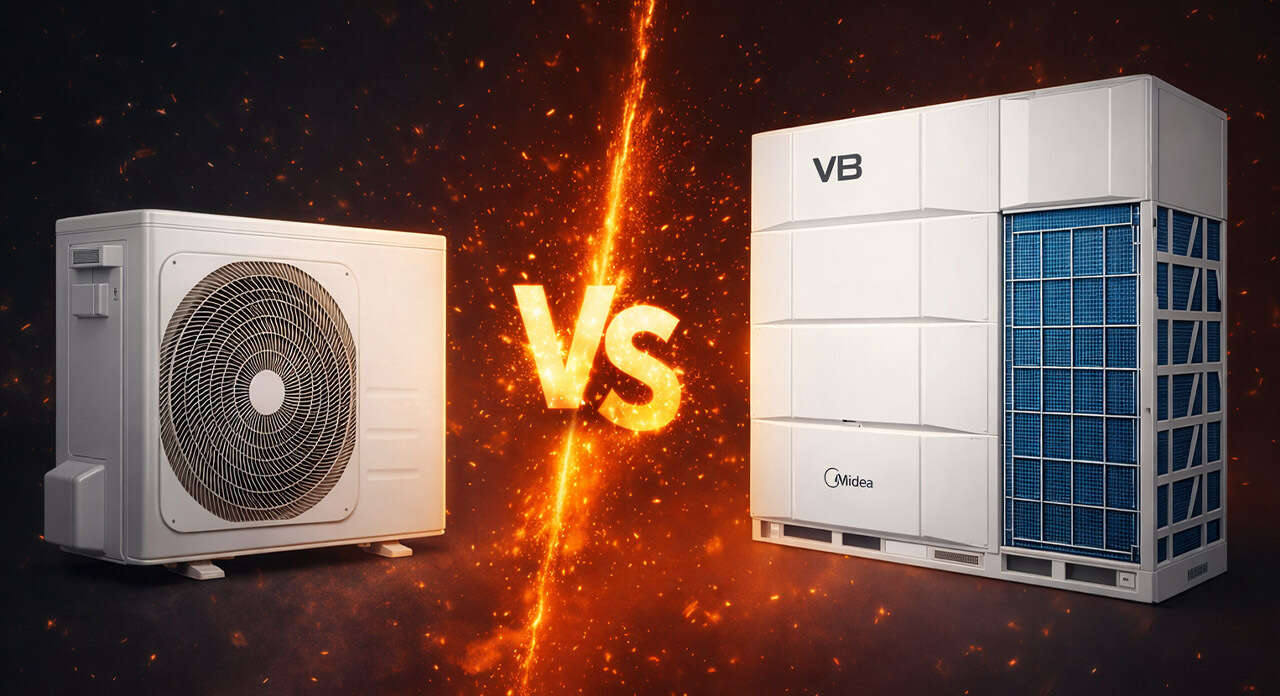
Choosing Between VRF and Split Air Conditioning Systems: A Practical Comparison
Selecting between a VRF system and split air conditioners is not merely a matter of comparing prices. These two systems differ significantly in system architecture, part-load energy efficiency, zoning and control capabilities, installation complexity, execution risks, maintenance costs, and performance in hot and humid climates.
This article provides a comprehensive and practical comparison to help both clients and HVAC engineers make a more informed decision.
Clear and Practical Definitions
What Is VRF (Variable Refrigerant Flow)?
VRF is a system in which one or more outdoor units regulate refrigerant flow based on actual load demand and serve multiple indoor units. Each indoor unit can have independent temperature control.
- Suitable for multi-zone projects (multiple rooms or spaces)
- Advanced control and monitoring capability (BMS / centralized control)
- In some models: Heat Recovery (simultaneous cooling and heating in different zones)
What Is a Split Air Conditioner?
A split air conditioner (wall-mounted, floor-standing, or cassette type) is typically an independent system serving a single space or a small zone (one outdoor unit + one indoor unit).
- Suitable for smaller units or independent spaces
- Easier and more common installation and maintenance
- Limited control (generally one unit per space)
System Architecture and Project Scale (Centralized vs. Independent)
- VRF: A relatively centralized system with multiple indoor units; ideal when the number of rooms or zones is high and independent control is required.
- Split: Each space has an independent system; suitable when there are few spaces or when the owner prefers full independence for each unit.
Rule of Thumb:
- Many spaces + independent control + office/hotel/clinic project → VRF
- Few limited spaces + fast and economical solution → Split
Energy Efficiency and Electricity Consumption
If we consider a single space with equal area, cooling load, and operating hours, inverter split units and VRF systems may initially appear to have similar electricity consumption. However, the real difference lies in how load is managed over time.
Why VRF Typically Consumes Less Energy in Practice:
- In VRF systems, one or more central inverter compressors manage the total building load, whereas in split systems each unit operates independently, often leading to overlapping energy consumption.
- VRF can redistribute capacity among zones—unused capacity in one space can be utilized elsewhere, a capability split systems lack.
- During real operating conditions (which are rarely full-load), VRF systems operate more steadily without frequent on/off cycling, resulting in more controlled power consumption.
- Even in projects with a limited number of units, coordinated compressor operation in VRF systems generally leads to lower and more stable cumulative energy use.
When Split Systems Can Still Make Sense:
In very small spaces with few units and limited operating hours, the short-term energy consumption difference between inverter split systems and VRF may not be significant.
However, as soon as the project scale increases (more spaces, longer operating hours, or higher zoning requirements), energy consumption and operating costs quickly shift in favor of VRF systems.
Summary:
- Short-term and simplified view → Split may appear cheaper
- Real operation and long-term perspective → VRF is usually more energy-efficient, economical, and intelligent
Temperature Control, Comfort, and Zoning
VRF:
- Independent control for each space (dedicated thermostats)
- More stable temperatures with less fluctuation
- Scheduling, access limitation, centralized control, and reporting capabilities
Split:
- Each unit controls only its own space
- Multiple rooms require multiple independent units
- Centralized and integrated control is usually limited or requires additional equipment
Installation Quality and Execution Risks
Why Is VRF Installation More Sensitive?
Unlike split systems, VRF is not a single standalone unit; it is an integrated refrigerant network whose overall performance depends heavily on installation quality. Key installation factors include:
Proper evacuation and drying of the refrigerant circuit:
Residual moisture or air can lead to acid formation, reduced efficiency, and long-term compressor damage—this is especially critical in VRF systems due to extensive piping.
Accurate refrigerant charging:
Undercharging or overcharging directly affects capacity, energy consumption, and compressor lifespan. When correctly charged, VRF systems operate efficiently across all load conditions.
Compliance with piping length, elevation differences, and oil return rules:
Observing these limits ensures proper oil return to the compressor and stable long-term operation.
Standard insulation and proper pipe supports:
Prevents condensation, energy loss, building damage, and mechanical stress on piping.
Accurate and multi-stage leak testing:
Even very small leaks can reduce capacity, increase energy consumption, and eventually damage compressors.
Why Does Split Installation Seem Easier?
- Shorter piping runs and simpler refrigerant circuits
- Installation errors usually have localized effects—failure of one unit only affects that specific space
For this reason, split systems involve lower execution risk in small projects or with less-experienced installation teams.
Key Point:
The higher sensitivity of VRF installation is not a weakness—it is a sign of a professional system. When installed by experienced teams under proper engineering supervision:
- VRF becomes a stable, low-energy, low-wear system
- The risk of cascading failures is minimized
- Long-term repair costs and system downtime are significantly reduced
Initial Cost (CAPEX) vs. Operating Cost (OPEX)
CAPEX | Purchase and Installation Cost
At first glance, VRF systems typically have higher initial costs than split systems due to:
- More advanced central equipment (multi-stage inverter compressors)
- Intelligent control systems and centralized management
- More extensive piping networks and precise design requirements
- Need for specialized installation teams and engineering supervision
Split systems, on the other hand:
- Have lower purchase and installation costs
- Are faster to install
- Are easier to commission in small or time-constrained projects
✅ Important Note:
Higher VRF CAPEX is not an extra cost—it is an investment in infrastructure that reduces hidden and long-term expenses.
OPEX | Electricity, Maintenance, and Repairs
This is where the real difference usually becomes clear.
VRF:
- Lower real-world electricity consumption due to precise capacity control and excellent part-load performance
- Optimized capacity sharing across zones instead of cumulative, uncoordinated consumption
- More uniform compressor wear, reducing unexpected failures over time
- Although parts and repairs are more specialized and expensive, longer service intervals and fewer failures largely offset these costs
Split:
- Appears simpler and cheaper to maintain initially
- As the number of units increases:
- Cumulative electricity consumption rises
- Frequency of failures and service visits increases
- Hidden costs (PCB replacement, compressor failure, repeated refrigerant charging) gradually accumulate
- Non-inverter split systems have significantly higher electricity consumption, especially during peak hours
Financial Decision Summary: VRF vs. Split
From a professional, long-term, and life-cycle cost perspective, VRF systems generally provide better energy performance, more reliable operation, and lower total cost of ownership—especially in medium to large, multi-zone projects.
| Client’s Perspective | Comparison Result | Logical Choice |
|---|---|---|
| Focus on the Lowest Initial Cost | Lower CAPEX, faster installation, without considering future costs | Split System |
| Focus on Actual Electricity Consumption | Precise capacity control, lower energy consumption in long-term operation | VRF |
| Multi-Zone Projects or Projects with Multiple Units | Centralized control and prevention of cumulative energy consumption | VRF |
| Long Operating Hours (Office, Commercial, Medical) | Lower OPEX and reduced wear and tear in the long term | VRF |
| Life Cycle Cost Perspective | Return on investment through energy savings and maintenance reduction | VRF |
| Professional and Forward-Looking Client | System stability, cost control, and added project value | VRF |
Maintenance and Periodic Servicing of Systems
VRF System:
Due to their technical complexity and integrated design, VRF systems require trained technicians equipped with specialized tools. Typical maintenance procedures include centralized fault monitoring, diagnostics using advanced error codes, and checking the overall health of the refrigerant circuit (including pressure, temperature, and inverter performance). Since multiple indoor units are connected to a single outdoor unit, failure of an outdoor unit can disrupt the operation of part of the building (or, in some designs, the entire system). Therefore, preventive maintenance planning and access to specialized technical support are critical for these systems.
Split Systems:
In contrast, split systems have simpler maintenance requirements. Routine service typically includes cleaning filters and coils, checking for possible refrigerant leaks, and refrigerant charging if required. Because each unit operates independently, failure of one split unit only affects its own space and does not impact other areas of the building. This independence makes maintenance management and scheduling easier for owners and service technicians.
Noise, Aesthetics, and Architectural Constraints
In VRF systems, the ability to connect a large number of indoor units to a limited number of outdoor units usually reduces the total number of condensers, which are concentrated in one or a few designated locations. With proper design of outdoor unit placement, this helps keep building façades, balconies, and public spaces more organized and visually integrated, imposing fewer architectural constraints on designers. In addition, locating outdoor units farther from occupied areas generally results in lower perceived indoor noise levels.
Another advantage of VRF systems is the wide variety of indoor unit options. Indoor units can be selected in different configurations such as concealed ceiling-mounted, cassette, wall-mounted, ducted with various static pressures, or floor-mounted units. This flexibility allows architects and interior designers to align the HVAC system with interior design concepts, ceiling heights, and space limitations without the equipment becoming visually dominant or intrusive.
By contrast, in multi-room buildings or projects with a large number of independent spaces, using split systems typically leads to the installation of numerous outdoor units. This can clutter building façades, balconies, and terraces, and in many projects may conflict with architectural constraints, municipal regulations, or cause dissatisfaction among clients and occupants. In addition, split systems offer more limited indoor unit variety, resulting in less flexibility for coordination with interior design.
Architectural and Visual Summary
If façade aesthetics, noise control, design flexibility, and minimizing architectural constraints are important for a project, VRF systems are a far more flexible and professional option compared to split systems.
Recommended Article
“Comparison of VRF Systems and Chillers”
Performance in Hot and Humid Climates (Southern Regions)
In hot and humid cities, several factors become more critical:
- Capacity reduction at high ambient temperatures
- Higher compressor operating pressures
- The importance of dehumidification and latent load control
- Condenser quality and maintenance (regular cleaning)
VRF Systems in Harsh Climates Typically:
- Provide better capacity control
- Offer superior part-load management
- Require very precise installation and regular servicing
Split Systems:
- When used in large numbers, lead to higher energy consumption and wear
- High-quality inverter models can be adequate, but for multi-zone projects they are generally not the most economical or manageable option
Quick Comparison Table
| Criteria | VRF | Split System |
|---|---|---|
| System Type | Multi-Zone / Central | Independent for Each Space |
| Initial Cost | Higher | Lower |
| Electricity Consumption in Long-Term Operation | Usually lower | Usually higher |
| Part-Load Performance | Very good | Moderate to good |
| Independent Room Control | Excellent | Only the same room |
| Proper Installation | Sensitive and specialized | Simpler |
| Refrigerant Leakage Risk | Important and impactful | More limited |
| Building Façade | More organized (with proper design) | Possible clutter of outdoor units |
| Suitable For | Office / Hotel / Clinic / Commercial | Small residential units / limited spaces |
HVAC System Selection Scenarios
In most medium to large residential, office, commercial, hotel, healthcare, educational, and public projects, the VRF system is recognized as a standard and professional HVAC solution, as it simultaneously addresses the need for independent zone control, energy efficiency, architectural constraints, and centralized management.
VRF Is Recommended If:
In projects with a large number of rooms or zones—such as multi-story office buildings, residential towers, hotels, hospitals, clinics, universities, and educational institutions—VRF enables independent temperature control for each space without increasing cumulative energy consumption.
In applications with long operating hours (office, commercial, healthcare, and hotels), where electricity cost is a determining factor in operation, VRF systems typically result in lower long-term operating costs due to optimized part-load performance and intelligent capacity management.
If a project requires centralized management and monitoring—such as large office buildings, healthcare facilities, or educational campuses—VRF provides building-level control, fault monitoring, scheduling, and energy consumption optimization.
In buildings with architectural façade limitations, balcony restrictions, or municipal regulations (such as residential towers, hotels, and landmark commercial projects), consolidating VRF outdoor units helps maintain a cleaner, more professional appearance without visual clutter.
In summary, the application of VRF systems in medium- to large-scale projects—where the client’s approach is long-term, professional, and based on life cycle cost analysis—is a logical, cost-effective choice aligned with current HVAC industry standards.
Split Systems Are Recommended If:
In small or very limited projects with a low number of spaces (such as a small residential unit or temporary use), where the initial budget is limited and fast installation is a priority, split systems can be a more suitable option.
Additionally, if system operation is low, seasonal, or intermittent, and long-term energy consumption differences do not significantly impact the overall project cost, choosing split systems can be economically justifiable.
In these scenarios, ease of installation, easy access to general service technicians, and the independence of each unit from centralized control are more important than energy efficiency and integrated management.


