


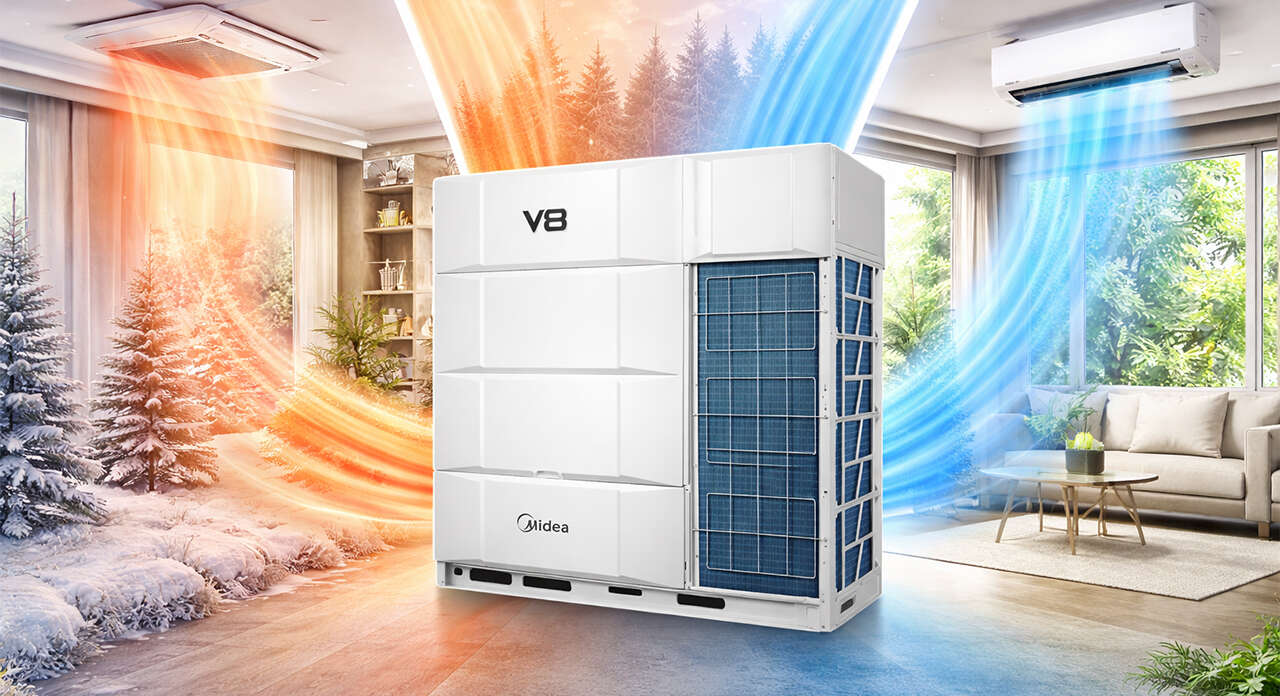
The VRF (Variable Refrigerant Flow) system is a new generation of central air conditioning that has become popular in modern projects due to its intelligent temperature control, low energy consumption, and flexible design.
However, the main question for most engineers and project owners is:
“What are the types of VRF systems, and how do they differ in application?”
In this article, we technically and practically examine the three main types of VRF systems:
1. Cooling-Only VRF
This system is designed solely to produce cold air and does not include a heating circuit or a four-way (reversing) valve.
In practice, this type of VRF only provides cooling. If heating is needed, other systems such as a boiler room or package unit must be used.
Technical Configuration
- Inverter compressor with precise speed control
- Single-path refrigerant piping
- Electronic expansion valve for each indoor unit
- No reversing valve
Advantages
✅ Lower total cost compared to other VRF types
✅ High cooling efficiency in hot climates
✅ Simpler design and easier maintenance
✅ Less wear due to single-function operation
Limitations
❌ No heating capability
❌ Requires a supplemental heating system in cold seasons
Applications
- Industrial projects in hot climates
- Data centers
- Retail stores and commercial complexes
- Buildings with central heating
📌 Note: In buildings where heating is provided by boilers or radiators, choosing a cooling-only VRF is entirely economical.
2. Heat Pump VRF
The Heat Pump VRF system uses a four-way (reversing) valve to change the refrigerant flow direction, which allows it to produce warm air in winter and cool air in summer.
However, the key point is that the system can operate in only one mode at a time—either cooling or heating.
Operation
- In cooling mode, the refrigerant absorbs heat from the indoor space and releases it through the outdoor unit.
- In heating mode, the direction of refrigerant flow is reversed, and the indoor units deliver heat to the space.
Technical Advantages
✅ Eliminates the need for a separate heating system
✅ High efficiency due to variable-speed compressor control
✅ More economical than heat recovery models
✅ Simpler piping and control network design
Limitation
❌ Cannot provide simultaneous cooling and heating
Best Applications
- Residential towers
- Office buildings with similar simultaneous loads
- Projects located in moderate climates
📊 According to global manufacturers, more than 70% of standard projects use Heat Pump VRF systems, as they offer a perfect balance of cost, efficiency, and energy performance.
3. Heat Recovery VRF
In a Heat Recovery VRF system, the unit can simultaneously provide cooling in some parts of the building and heating in others.
This functionality is enabled by a BC Controller module (or Energy Recovery Box), which recovers the heat rejected during the cooling process and transfers it to areas needing heating.
Operation
- In eastern or southern zones of the building (usually warmer), the system operates in cooling mode.
- At the same time, the rejected energy is transferred through the refrigerant loop to northern or cooler zones, providing heating.
- Thus, the system uses internal building energy for heating without additional electricity or gas consumption.
Advantages
✅ Highest energy efficiency among all VRF types
✅ Simultaneous cooling and heating
✅ Independent temperature control in each zone
✅ Stable and precise thermal comfort
✅ Ideal for multi-use projects with continuous operation
Limitations
❌ Higher initial cost
Applications
- Hotels (guest rooms in cooling mode, corridors in heating mode)
- Hospitals (patient rooms and northern sections)
- Large commercial buildings and mixed-use complexes
- Educational and research centers with diverse simultaneous thermal demands
📈 From an economic point of view, despite the higher initial installation cost, energy savings often result in a payback period of less than three years.
Technical Comparison Between Types of VRF Systems
Key Features | Cooling-Only VRF | Heat Pump VRF | Heat Recovery VRF |
|---|---|---|---|
Cooling | ✅ Available | ✅ Available | ✅ Available |
Heating | ❌ Not Available | ✅ Available | ✅ Available |
Simultaneous Cooling and Heating | ❌ Not Available | ❌ Not Available | ✅ Available |
Energy Consumption | Low | Medium | Very Low |
Installation Complexity | Low | Medium | High |
Initial Cost | Low | Medium | High |
Suitable for Which Type of Project? | Hot Climate, Industrial | Office, Residential | Hotel, Hospital, Luxury Projects |
Comparison of VRF Systems
Before selecting the appropriate system, this question is usually raised:
What is the difference between a chiller and a VRF system?
Or,
How does VRF compare with split air conditioners in terms of energy consumption, cost, and application?
Main Advantage of VRF Compared to Split Air Conditioners
In all types of VRF systems, temperature control for each indoor unit is completely independent. By intelligently adjusting the refrigerant flow based on actual demand, VRF systems can reduce electricity consumption by up to 50% compared to traditional systems such as conventional split air conditioners.
Implementation of VRF Systems in Ahvaz
In the hot-climate regions of the country, the use of advanced VRF systems is particularly important.
In this field, Avash Sepidar Sepehr Company, as an authorized VRF system representative in Ahvaz, works with reputable brands such as Midea and Lennox, providing specialized design, sales, and execution services for VRF systems throughout Khuzestan Province.
Final Summary
Choosing the right type of VRF system should not be based on price alone;
rather, it must be determined through accurate analysis of thermal load, climate conditions, and building usage.
🔹 Cooling-Only VRF: Economical, simple, and reliable
🔹 Heat Pump VRF: Excellent balance between energy consumption and cost
🔹 Heat Recovery VRF: Highest available technology and maximum efficiency
Ultimately, VRF systems offer a solution capable of delivering comfort, efficiency, and energy optimization simultaneously within a single project.
Answers to 3 Common User Questions About VRF Types
No, this model is designed for buildings that already have a separate heating system.
Heat Pump systems cannot provide cooling and heating simultaneously, but Heat Recovery systems can do so and also recover energy.
If you have a typical or office project ⬅ Heat Pump VRF
If you have a hotel or multi-functional project ⬅ Heat Recovery VRF
If you only need cooling ⬅ Cooling-Only VRF


