


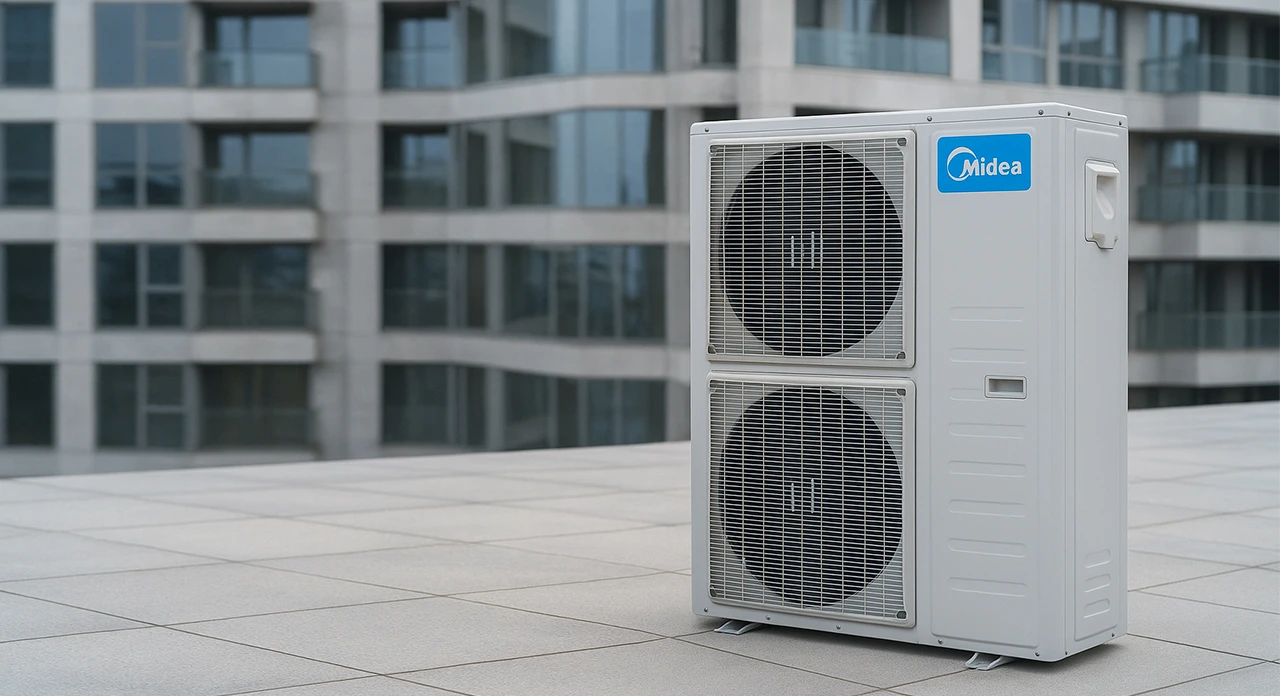
Everything About Choosing the Right Ducted Split Capacity and Accurate Calculation Methods
In the field of HVAC, one of the most common mistakes when purchasing a ducted split system is selecting an inappropriate capacity. If the capacity is too low, the unit operates under excessive pressure and cannot maintain the desired temperature. If the capacity is too high, the system will cycle on and off frequently, energy consumption will increase, and temperature and humidity control will be poor.
In this article, you will learn step by step how to choose the appropriate ducted split capacity based on your building’s area, in a way that ensures comfort while keeping costs under control.
Basic Concepts You Should Know
BTU/hr: A cooling/heating unit that indicates the amount of energy a system can transfer in one hour.
Refrigeration Ton: Commonly used in the HVAC industry; every 12,000 BTU/hr is approximately equal to one refrigeration ton.
Regional Coefficient / Correction Factor: A value added to calculations to compensate for climate conditions, solar radiation, insulation quality, and environmental factors.
Actual Cooling Load: The precise cooling requirement calculated based on comprehensive factors such as walls, windows, equipment, occupants, and more.
Capacity Calculation Based on Area (Rule‑of‑Thumb Method)
The rule‑of‑thumb method is one way to estimate ducted split capacity based on building area and an approximate regional coefficient. However, this method is only an estimation and approximation. For professional design and large projects, the correct and standard approach is an accurate capacity calculation.
General Steps for Approximate Estimation
Measuring the usable area:
First, determine the effective area that actually requires cooling or heating. For example, if a residential unit has an area of 120 square meters, this figure becomes the basis for calculation.
Determining the regional coefficient:
Each city or region is categorized into one of four groups based on climate conditions: Group 1, Group 2, Group 3, and Group 4. Each group has a different coefficient for approximate capacity calculation.
Estimating the approximate capacity:
The approximate capacity is obtained by multiplying the usable area by the regional group coefficient. This calculation provides only an estimated value and cannot account for real factors such as solar radiation, building insulation, ceiling height, or internal heat‑generating equipment.
Approximate Example for a 120 m² Unit
- Group 1: Approx. 48,000 BTU/hr
- Group 2: Approx. 48,000 BTU/hr
- Group 3: Approx. 60,000 BTU/hr
- Group 4: Approx. 84,000 BTU/hr
This method is used solely to obtain an approximate figure and should not be considered a precise design criterion.
Accurate Method for Calculating Ducted Split Capacity
For large buildings and sensitive projects such as high‑area residential buildings, office complexes, and commercial projects, the rule‑of‑thumb method is not sufficient. In these cases, accurate ducted split capacity calculation is essential to ensure proper system performance and reduced energy consumption.
Characteristics of the Accurate Method
This method requires detailed engineering information, including:
- Exact building area and architectural drawings
- Energy losses through walls, ceilings, doors, and windows
- Solar radiation angle and window orientation
- Arrangement of lighting fixtures and other heat sources
- Regional climate conditions and wind patterns
All of this data is collected by specialized engineers and analyzed using professional software such as Carrier HAP.
Calculation Steps
Precise identification of conditioned spaces:
Ceiling height, room areas, and the usage type of each space are defined.
Analysis of climate conditions and solar radiation:
Temperature, humidity, and the intensity and angle of solar radiation throughout the year are evaluated.
Evaluation of materials and insulation:
Wall, ceiling, and window materials, as well as thermal transfer rates, are included in the calculations.
Calculation of internal heat loads:
The number of occupants, heat‑generating equipment, and lighting that affect temperature are considered.
Calculation of external cooling load and duct pressure losses:
Direct solar exposure, building orientation, and duct routing increase cooling demand and must be compensated for.
Use of specialized software:
All data is entered into software such as HAP to calculate the exact cooling load and determine the actual system capacity in BTU/hr or refrigeration tons.
Applications and Key Points of the Accurate Method
This method is a common standard in the design of various HVAC systems.
The results ensure the selection of an accurately sized and optimized unit, improving ducted split performance, reducing energy consumption, and maximizing occupant comfort.
Conclusion
Choosing the appropriate ducted split capacity is a critical step in HVAC system design. Proper capacity selection ensures optimal temperature and humidity control while reducing energy consumption.
Based on the usable building area and city group classification, rule‑of‑thumb methods can be used to obtain an approximate figure. However, this approach cannot account for real‑world factors such as solar radiation, insulation quality, ceiling height, and internal heat sources.
Therefore, while approximate capacity calculations based on area and regional coefficients can provide an initial overview, the accurate method—considering all engineering factors—offers greater reliability for proper system performance.
Overall, understanding usable area, determining the regional group, and grasping the basic principles of cooling load calculation help users and engineers better estimate the appropriate ducted split capacity and plan HVAC systems more effectively.


