


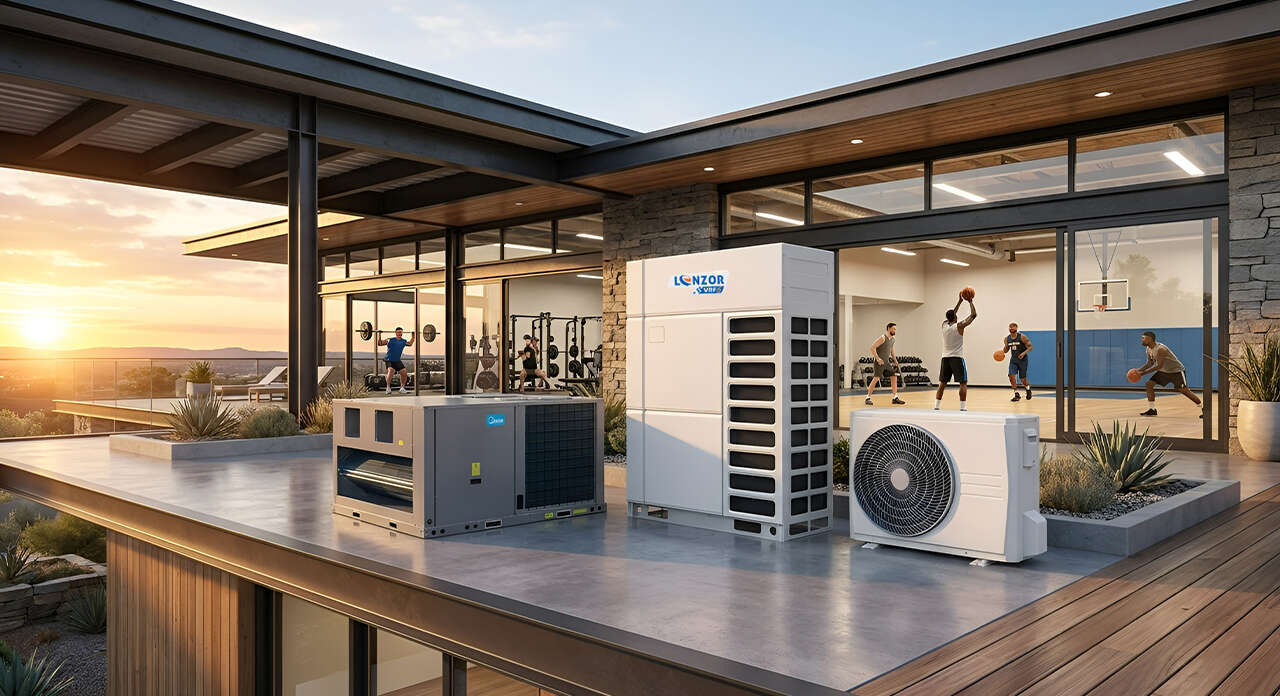
Selecting the best HVAC system for a gym is not just a technical decision; it is a critical factor that directly affects the health, performance, and satisfaction of athletes. In a fitness environment, intense physical activity leads to increased temperature, humidity, sweating, and the production of pollutants such as CO₂. Therefore, a conventional cooling system can never provide the indoor air quality required for a standard gym.
To maintain a cool, odor‑free environment with fresh air and controlled temperature, a gym must use a system that provides cooling and heating along with effective ventilation and fresh air supply. Many gyms mistakenly focus only on cooling capacity, while in reality, air quality is the most important factor.
In this article, we review global ventilation standards for sports facilities, fresh air requirements, required capacity, and the most suitable equipment for gyms. We then compare three main systems—rooftop package units, ducted split systems, and VRF systems—to help you choose the most appropriate option for your gym with full awareness.
Why Is HVAC Critically Important in a Gym?
The absence of a proper HVAC system in a gym can cause serious problems for both athletes and gym management. In an environment where people are constantly exercising, heat, humidity, and respiratory pollutants build up rapidly. If the ventilation system is not properly designed, the air quickly becomes heavy and polluted, and training quality drops significantly.
For this reason, one of the most important principles in gym design is using a proper gym ventilation system—a system that can simultaneously control temperature, humidity, and air quality. Below are the main problems caused by inadequate ventilation in gyms.
Problems Caused by Poor Ventilation in Gyms
Poor ventilation is one of the most common issues in fitness centers. Many gym owners underestimate it at first, but in practice, it can severely affect workout quality, customer satisfaction, and even athletes’ health. Due to high occupancy, excessive sweating, and continuous equipment operation, a gym that is not properly ventilated quickly becomes hot, humid, and polluted.
Increased Temperature and Suffocation Feeling
In gyms without efficient ventilation, indoor temperature rises rapidly. The combination of human activity, intense workouts, and heat generated by equipment causes the space to exceed acceptable temperature limits.
Incorrect actions such as:
- Using standard split air conditioners without fresh air intake
- Closing air vents to “make the space colder”
- Turning off ventilation systems to save energy
cause air stagnation and create a suffocating environment.
This results in:
- Reduced athlete energy
- Excessive sweating
- Increased heart rate
- Higher risk of heat exhaustion
making the environment unsuitable for proper training.
CO₂ Accumulation and Oxygen Reduction
Gyms are among the spaces with very high CO₂ generation. With every breath, athletes release large amounts of carbon dioxide, and without proper air exchange, CO₂ levels rise rapidly.
The result of CO₂ accumulation includes:
- Reduced available oxygen
- Early fatigue
- Headaches and heaviness
- Decreased focus and training efficiency
- Potential cardiovascular and respiratory risks
This issue occurs precisely when the ventilation system fails to supply sufficient fresh air—something standard air conditioners cannot solve, as they only recirculate indoor air.
Reduced Air Quality and Training Efficiency
Polluted, hot, and oxygen‑deficient air immediately affects workout quality. Spending just a few minutes in a poorly ventilated gym can lead to:
- Shortness of breath
- Reduced exercise speed
- Decreased strength and endurance
- Lower motivation and focus
- Abnormal fatigue
Beyond performance issues, this condition often causes members to lose interest in continuing their gym membership.
Temperature, Humidity, and Fresh Air Standards for Gyms
For a gym to achieve ideal indoor air quality, three key parameters—temperature, humidity, and fresh air supply—must be controlled according to ASHRAE guidelines. These standards directly affect comfort, health, physical performance, and prevention of early fatigue.
According to international standards:
-
Optimal temperature: 20–24 °C
- Weight training areas: 20–22 °C
- Group classes: 22–24 °C
Temperatures below this increase injury risk, while higher temperatures cause faster fatigue and elevated heart rate.
-
Relative humidity: 40–60%
Low humidity dries skin and respiratory passages, while high humidity promotes mold, odors, and microbial growth. Humidity control is a core function of a proper HVAC system—something standard AC units cannot manage effectively.
-
Fresh air requirement:
Based on ASHRAE 62.1, gyms require 20–25 CFM of fresh air per person. In high‑occupancy gyms, this can quickly reach hundreds or thousands of CFM. Without sufficient fresh air, CO₂ levels rise, oxygen drops, and discomfort follows.
-
Air changes per hour (ACH):
Gyms should achieve 4–8 air changes per hour, and high‑intensity areas such as CrossFit zones may require up to 10 ACH to prevent odor, humidity, and pollutant buildup.
-
Filtration:
Minimum MERV 8, preferably MERV 11–13, to remove dust and airborne particles. In polluted urban areas, activated carbon filters are recommended to reduce odors and harmful gases.
In summary, maintaining proper temperature, humidity, and fresh air is essential for athlete health and forms the foundation of a properly designed gym HVAC system.
Key Factors in Choosing an HVAC System for a Gym
Selecting the right HVAC system for a gym goes far beyond cooling or heating capacity. Due to high occupancy, intense activity, and heat generation, gyms have very different requirements compared to residential or office spaces.
Area, Air Volume, and Ceiling Height
Larger spaces and higher ceilings require systems capable of delivering higher airflow (CFM). Rooftop package units are ideal for large or high‑ceiling gyms, while ducted splits may work for smaller spaces.
Occupancy and Peak Hours
HVAC systems must be designed based on maximum occupancy, not average usage. During peak hours, heat, humidity, and CO₂ production increase dramatically.
Type of Activity and Heat Load
High‑intensity training (CrossFit, HIIT, cardio classes) produces far more heat and moisture than traditional weight training, requiring higher airflow, fresh air rates, and faster cooling response.
Climate Conditions
- Hot & humid: strong dehumidification required
- Hot & dry: energy efficiency and cooling capacity
- Cold regions: heating capacity and efficiency
- Polluted cities: advanced filtration and carbon filters
Budget, Energy Consumption, and Maintenance
- Ducted split: lower initial cost, higher energy use, needs separate fresh air system
- VRF: high initial cost, very energy‑efficient
- Rooftop package: mid‑to‑high cost, complete solution for gyms
Best HVAC Systems for Gyms
Rooftop Package Units – The Best Choice for True Fresh Air
Rooftop package units are among the most professional solutions for gyms. Installed on the roof, they provide cooling, heating, and large volumes of fresh air in a single integrated system.
Key advantages:
- High fresh air capacity
- Effective removal of odors and CO₂
- Ideal for large gyms
- Fewer indoor units and easier maintenance
Ducted Split Systems – An Economical Option for Small to Medium Gyms
Ducted split systems distribute conditioned air via ducts and have lower initial costs. However, they do not provide fresh air by default and require additional ventilation systems for gym use.
Suitable for:
- Small gyms
- Low‑density training spaces
- Medium‑sized facilities with supplemental ventilation
VRF Systems – A Premium Solution for Multi‑Zone and Luxury Gyms
VRF systems allow multiple indoor units with independent temperature control, making them ideal for gyms with multiple functional areas.
Key advantages:
- Excellent energy efficiency
- Independent zone control
- Quiet operation
- Ideal for modern, high‑end fitness centers
Although initial costs are higher, VRF systems are one of the best long‑term HVAC solutions for large and advanced gyms.
Performance Comparison of HVAC Systems for Gyms
To select the best HVAC system for a gym, systems must be compared based on:
- Fresh air capability
- Energy efficiency
- Cooling performance
- Initial investment cost
Rooftop package units excel in ventilation, VRF systems lead in energy efficiency and control, while ducted splits remain a budget‑friendly option for smaller facilities.
Choosing the right system ultimately depends on gym size, occupancy, activity type, climate, and budget—not on cooling power alone.
| Comparison Criteria | Rooftop Package Unit | Ducted Split System |
VRF |
Best Performance |
|---|---|---|---|---|
| Fresh Air Supply | Large volume fresh air intake | Requires a separate ventilation system | Requires a separate ventilation system | Rooftop Package Unit |
|
Energy Consumption |
Medium |
Medium to High | Very Low and Efficient |
VRF |
| Cooling Performance | Very powerful, suitable for large spaces | Good for small spaces | Very precise and stable | Rooftop Package / VRF |
| Initial Equipment Cost |
Medium |
Low and economical | Relatively high | Ducted Split System |
| Final Recommendation | Suitable for large and high‑traffic gyms | Suitable for small gyms | Suitable for modern multi‑zone gyms |
_ |
Which HVAC System Is More Suitable for Each Type of Gym?
Choosing the best HVAC system for a gym depends entirely on the floor area, type of physical activities, occupancy density, and the need for fresh air. Every gym has different conditions, and a single system cannot be ideal for all of them. Below, we briefly explain which HVAC system is more suitable for each type of fitness center.
Small gyms with an area of less than 120 square meters usually have lower air volume, fewer occupants, and less intense activities. For this reason, a ducted split system is often the best option. It has a relatively low initial cost, is easy to install, and can adequately meet the cooling needs of such spaces. The only important consideration is that a fresh air fan or ventilation inlet should be installed to maintain proper air quality during peak hours.
In medium‑sized gyms between 120 and 300 square meters, the level of activity increases, occupancy becomes higher, and the need for stronger ventilation becomes more noticeable. In this range, a rooftop package unit is usually the best choice because it can provide both cooling and fresh air supply to the space. This system is ideal for facilities that experience peak usage hours. In some projects, a ducted split combined with an air handling unit (AHU) is also used, but rooftop package units generally provide a more complete and reliable performance.
For large gyms with an area of more than 300 square meters, the main priorities are the ability to supply sufficient fresh air, strong cooling capacity, and stable temperature control within a large air volume. For this reason, rooftop package units are usually the most reliable option. These systems are designed specifically for large spaces and can maintain stable temperatures while continuously supplying fresh air even during peak operating hours. In luxury facilities, a VRF system combined with a fresh air handling unit may also be used, but in terms of standard performance, rooftop packages are often considered superior.
In gyms that include separate activity rooms such as yoga, CrossFit, spinning, or TRX, independent temperature control becomes very important because each space has a different level of activity, sweating, and occupancy. In these cases, a VRF system is usually the best solution because each room can have its own thermostat, allowing precise temperature control while maintaining high energy efficiency. Typically, a fresh air handling unit is also installed alongside the VRF system to supply ventilation for the entire facility.
Calculating the Required HVAC Capacity for a Gym
Calculating the correct HVAC capacity is one of the most critical steps in designing a gym ventilation system. Unlike typical buildings, gyms generate significantly higher heat loads. High occupancy, intense physical activity, fitness equipment, and powerful lighting all increase the cooling demand, meaning HVAC systems must often be sized larger than standard building calculations.
The first step is cooling load calculation. Gyms generally have higher cooling loads than offices or commercial spaces because the indoor temperature must remain stable between 20–24°C, even during peak activity. In professional design, cooling load is calculated based on floor area, air volume, number of windows, geographic location, and solar radiation. However, busy gyms usually require higher capacity than standard estimates.
The number of occupants also plays a major role. During intense exercise, each person can generate 350 to 600 watts of heat. During peak hours, this heat load increases rapidly, and if the HVAC system lacks sufficient capacity, the temperature rises quickly and the environment becomes uncomfortable. Therefore, the number of people present during peak hours is more important than total membership when determining system capacity.
Fitness equipment and artificial lighting must also be considered. Cardio machines such as treadmills, ellipticals, and spinning bikes generate considerable heat while operating. Additionally, LED lighting and powerful projectors—commonly used in modern gyms—contribute to the total heat load. Together, equipment and lighting can add 15–30% to the final cooling load.
Choosing either too little or too much capacity can create problems. If the capacity is too low, the system runs continuously, fails to reach the desired temperature, humidity rises, and occupants feel fatigue and discomfort. This directly affects workout quality and customer satisfaction. On the other hand, oversized systems cause frequent on‑off cycling, higher energy consumption, reduced compressor lifespan, and temperature fluctuations. Therefore, selecting the correct capacity based on real operating conditions is essential for stable and professional gym ventilation.
Principles of Proper HVAC Design and Installation in Gyms
Designing a gym HVAC system is not limited to selecting the right equipment. Even the best systems cannot perform effectively if ductwork design, diffuser placement, or airflow distribution are incorrect. Proper engineering design ensures uniform, cool, and healthy air circulation throughout the facility.
One of the most important aspects is the proper placement of supply and return air diffusers. Supply diffusers should distribute cool air evenly across the space without blowing directly onto people. Return vents should be positioned to collect warm and contaminated air efficiently and send it back to the system. Proper design ensures continuous air circulation throughout the gym.
Another important factor is preventing dead zones and heat accumulation. Dead zones often occur in corners, under platforms, or near large fitness equipment. If airflow does not reach these areas, local temperatures increase and air quality deteriorates. Proper duct routing and the use of multiple air diffusers help eliminate these issues.
Equally important is uniform air distribution. In a well‑designed gym, there should not be noticeable temperature differences between different areas. To achieve this, the number of diffusers, airflow velocity, and duct layout must be designed to distribute air evenly throughout the entire space.
For gyms with multiple sections, zoned ventilation is often necessary. Areas such as weight training zones, CrossFit rooms, yoga studios, locker rooms, and showers all have different thermal conditions and therefore require independent temperature control.
In many projects, a combination of HVAC systems provides the best solution. For example, the main hall may use a rooftop package unit, while smaller rooms utilize VRF systems or ducted splits. This approach ensures adequate fresh air supply while also allowing independent temperature control in different areas. Hybrid HVAC design is one of the most common strategies for large and professional gyms.
Common Mistakes in Gym HVAC Selection and Design
Incorrect HVAC design can lead to wasted investment and dissatisfied gym members. One of the biggest mistakes is ignoring fresh air supply. Many people assume that cooling alone is sufficient, but in gyms continuous oxygen supply is essential for removing odors and CO₂.
Another common mistake is underestimating the required capacity by ignoring the heat generated by occupants and equipment. This causes the system to operate under constant strain and prevents the gym from reaching the desired temperature.
Improper ductwork and diffuser installation can also create dead zones with no airflow or direct cold drafts on athletes, which can be uncomfortable. Finally, focusing solely on low purchase cost while ignoring filtration quality and humidity control can create an unhealthy environment and lead to higher maintenance and electricity costs over time.
Successful Gym HVAC Projects
Reviewing real projects can provide a clearer understanding of system performance and selection. Below are two successful projects implemented in Khuzestan Province, designed for hot and humid climate conditions.
Megafit Gym – Ahvaz
In this project, six 30‑ton rooftop package units from the Trust brand were installed. Conditioned air is distributed through pre‑insulated ducts, allowing precise temperature and humidity control. Because of the sports facility usage, the system also includes heat recovery technology, which recovers energy from exhaust air to increase efficiency, reduce energy consumption, and supply fresh air with higher quality. As a result, the gym maintains consistently fresh and uniform air conditions.
Hanofit Gym – Ahvaz
In this gym, two 30‑ton rooftop package units from the Midea brand were installed. These systems distribute cooled and humidity‑controlled air through pre‑insulated ductwork throughout the facility. The project design focused on both thermal comfort and energy optimization, resulting in a healthy indoor environment with stable temperature and lower operating costs compared to older systems.
Conclusion: What Is the Best HVAC System for a Gym?
The best HVAC system for a gym depends on several factors such as facility size, number of athletes, available budget, and the type of activities performed. As physical activity levels and occupancy increase, the need for stronger cooling capacity and higher fresh air supply also increases.
For small gyms, ducted split systems are often a practical solution.
For medium‑sized gyms, rooftop package units or ducted split systems combined with air handling units perform better.
For large or multi‑zone gyms, advanced systems such as rooftop package units or VRF systems are more effective.
From a cost perspective, ducted splits usually have lower initial costs but may become less efficient in larger spaces. Rooftop packages and VRF systems have higher initial investment but provide better efficiency, more precise temperature control, and easier maintenance in large projects.
Ultimately, the best HVAC solution for a gym is a system that not only provides sufficient cooling but also ensures continuous fresh air supply, effective filtration, and uniform air distribution. In many cases, combining a suitable cooling system with air handling units and exhaust fans provides the most reliable solution for creating a healthy, comfortable, and professional gym environment.


