


In today’s world, where energy costs are on the rise and environmental sustainability has gained paramount importance, choosing high-efficiency cooling systems has become a necessity. Whether you are looking to purchase an air conditioner for your home, or a VRF system or chiller for large-scale commercial or industrial projects in tropical cities such as Ahvaz, Abadan, and Dezful; in any case, one of the most critical factors for determining a device’s efficiency is the “EER Coefficient” or “Energy Efficiency Ratio.”
This article will help you fully understand the concept of EER, how it is calculated, and its significance in the selection and maintenance of HVAC (Heating, Ventilation, and Air Conditioning) systems.
What is EER? A Simple Definition of Energy Efficiency Ratio
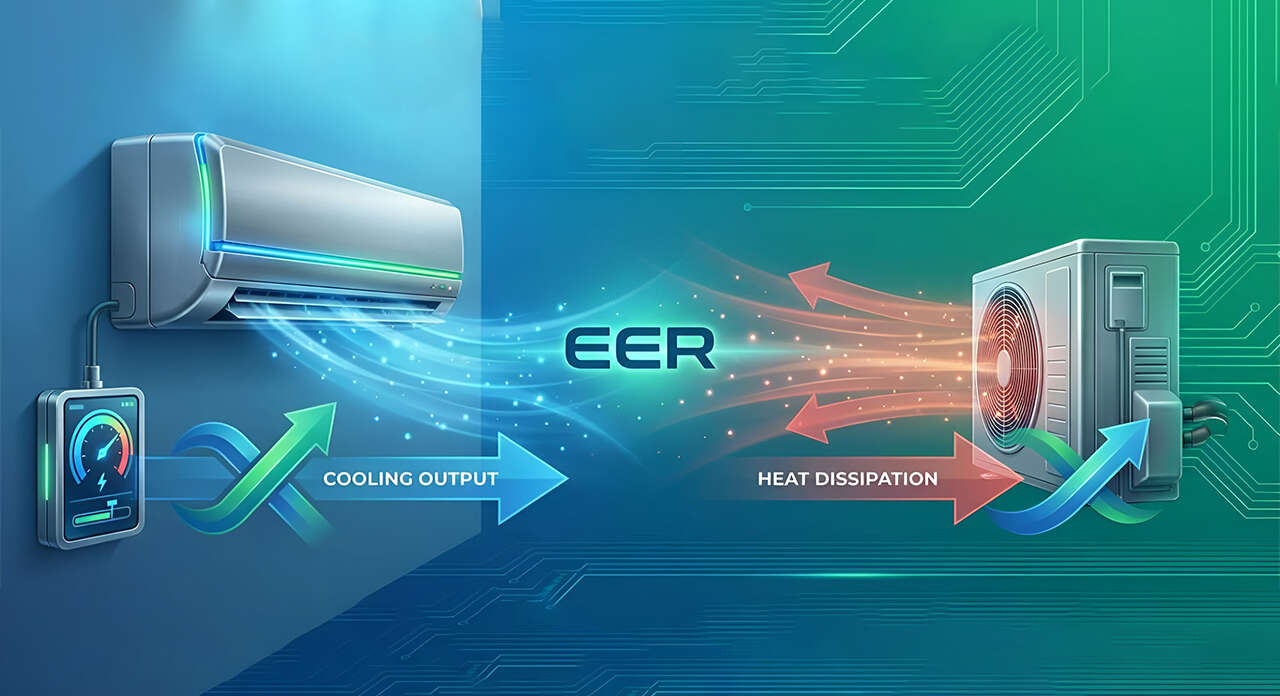
EER (short for Energy Efficiency Ratio) is a standard metric for measuring the efficiency of cooling systems such as air conditioners, chillers, split systems, and VRF systems. This coefficient indicates how much cooling a system produces for every unit of electrical energy (electricity) it consumes.
In simpler terms:
- Higher EER = Greater Efficiency: The higher the EER value of a device, the more cooling it generates with less electricity consumption.
- Cost Savings: High-EER devices significantly reduce your electricity consumption, resulting in lower power bills and long-term economic savings.
Note: The EER coefficient is particularly vital for regions with long, hot summers like Khuzestan (including cities like Ahvaz, Mahshahr, Omidiyeh, Behbahan, Izeh, and Shushtar); because in these areas, cooling systems operate for long hours at maximum capacity, and even a slight difference in EER can lead to major changes in electricity costs.
How to Measure and the Formula for Calculating EER
EER calculation is based on a simple formula that shows the relationship between cooling capacity and the power consumption of the device:
EER = Cooling Capacity (BTU/h) / Power Input or Electricity Consumption (Watt)
Cooling Capacity (BTU/h):
- BTU (British Thermal Unit) is a unit of measurement for thermal energy. The term BTU/h indicates the amount of heat a device can remove from an environment in one hour (i.e., the amount of cooling it produces).
- This number is usually mentioned in the technical specifications of the device (such as 9,000, 12,000, 18,000, 24,000, 36,000 BTU/h, and higher).
Power Input (Watt):
- This value represents the amount of electrical energy (electricity) the device consumes while producing cooling.
- This figure is also listed in the technical specifications (usually in Watts or Kilowatts).
Practical Example:
Assume an air conditioning unit has the following specifications:
- Cooling Capacity: 24,000 BTU/h
- Power Input (Electricity Consumption): 2,000 Watt
To calculate its EER:
EER = (24,000 BTU/h) / (2,000 Watt) = 12
Thus, the EER coefficient of this device is 12. The higher this number, the more efficient the device is.
Difference Between EER, SEER, and COP: Key Efficiency Indicators
In addition to EER, there are two other important indicators in evaluating the efficiency of HVAC systems that are essential to understand:
EER (Energy Efficiency Ratio)
- Measurement Method: EER measures the device’s efficiency under a single constant and standard operating condition (usually an outdoor temperature of 35°C and an indoor temperature of 27°C).
- Application: This coefficient is very useful for direct comparison of devices during peak usage conditions (like the hottest days of summer) and shows how efficient the device is under peak workload. For this reason, it is of particular importance for regions like Khuzestan and cities such as Khorramshahr, Abadan, and Shadegan where summer temperatures soar.
SEER (Seasonal Energy Efficiency Ratio)
- Measurement Method: SEER measures efficiency over an entire cooling season, taking into account temperature fluctuations and various loads. It provides a seasonal average of the device’s performance.
- Application: SEER gives the consumer a more comprehensive view of annual performance but may not provide complete information during peak load conditions when the device operates at maximum power.
COP (Coefficient of Performance)
- Measurement Method: COP is a coefficient used to measure efficiency in heating mode (e.g., in Heat Pump VRF systems or compression chillers). Its formula is similar to EER, with the difference that heating capacity (in Watts) is placed in the numerator.
- Application: For units with both heating and cooling capabilities, COP tells you how efficient the device is in heating mode.
Why is a High EER Vitally Important in Khuzestan and Ahvaz?
The climate of Khuzestan, characterized by extremely hot and long summers, high humidity in southern regions (such as Mahshahr, Bandar Imam Khomeini, Khorramshahr, and Abadan), and dust storms, presents unique challenges for HVAC systems. In these conditions, units must operate for many consecutive hours at maximum capacity.
Choosing systems with a higher EER in this region brings the following benefits:
- Significant Reduction in Electricity Bills: The primary benefit is the reduction of power costs. In Ahvaz, where electricity consumption skyrockets in summer, even a single unit difference in EER can lead to hundreds of thousands of Tomans in monthly savings.
- Increased Device Lifespan: High-EER devices are under less strain to produce cooling. This reduces the wear and tear on components, especially the compressor (the most expensive part), thereby extending the system’s lifespan. This is doubly important in cities like Masjed Soleyman and Izeh, where access to spare parts might be more difficult.
- More Stable Performance: More efficient units are better at maintaining the desired temperature even in the harshest weather conditions and are less prone to performance fluctuations or unexpected shutdowns.
- Environmental Protection: Lower energy consumption means fewer greenhouse gas emissions and a contribution to environmental sustainability.
How to Choose a Device with the Right EER?
For an optimal choice, consider the following tips:
- Check the Energy Label: All cooling devices have an energy label specifying their EER or SEER. Look for devices with an energy rating of A or B and a high EER.
- Compare Brands and Models: Reputable brands usually invest heavily in research and development to increase the efficiency of their products. Compare the technical specifications of different models.
- Consult with Specialists: For large projects (such as VRF systems for office or commercial buildings in Andimeshk, Shush, and Gotvand), be sure to consult with expert HVAC designers and installers to select a unit with the appropriate EER and capacity for your project’s specific conditions.
- Importance of Correct Installation: Even a device with a very high EER cannot achieve its optimal efficiency if not installed correctly. Ensuring professional and standard installation is a critical factor.
Conclusion: EER, the Key to Optimal and Sustainable Cooling
The EER coefficient is a fundamental criterion for evaluating the efficiency of cooling systems, ultimately helping you save on energy costs and increase your device’s lifespan. In a region like Khuzestan, where powerful and continuous cooling is vital, paying attention to a high EER is not just a smart choice but a necessity for comfort, economy, and sustainability.
By correctly understanding this concept and making an informed choice, you can enjoy pleasant and cost-effective cooling all year round.


